

CAT | ESP
  • EF NOTÍCIAS
    • España
    • Mundo
  • VIDEOS
    • Lecciones Financieras
    • Ver como lista
    • Ver todos
  • EF mapa
  • Agenda
  • Publicaciones EF
    • General
    • Documentos oficiales
    • Material Docente
  • ENLACES
    • RECURSOS
      • EN CASTELLANO
      • Internacionales
      • Blogs & Revistas
      • Aplicaciones
    • PROYECTOS
      • En Castellano
      • Internacionales
      • Gubernamentales
    • 5 mejores webs Educación Financiera en castellano
    • 7 webs educación financiera para jóvenes
    • 5 webs internacionales Educación Financiera
  • IEF
    • PROYECTOS IEF
      • EFEC
      • EFEP
    • DIVULGACIÓN IEF
  • Nosotros
Home La Educación Financiera es esencial para el desarrollo social y económico, según Naciones Unidas

La Educación Financiera es esencial para el desarrollo social y económico, según Naciones Unidas

28/7/2014 – The financial literacy industry is calling for a heightened focus on financial education in both developed and developing countries on the heels of the release by the United Nations Development Programme (UNDP) of its 2014 Human Development Report, which highlights alarming realities, including that nearly 1.5 billion people in 91 developing countries live in poverty, with another 800 million people currently at risk of falling back into poverty if financial or other setbacks occur.

Financial literacy proponents are moving ahead aggressively in an effort help prevent financial setbacks for the hundreds of millions of individuals and families who comprise vulnerable populations that are exposed to greater financial stress by virtue of their lack of financial education. The United Nations report comes at a critical time, not only as the tenuous global economy continues to hamper employment, housing and overall personal financial growth, but it also comes just days after the release of results of the first-ever global financial literacy study conducted by the OECD Programme for International Student Assessment (PISA), which tested 15-year-olds internationally regarding their understanding of critical personal financial concepts. With results of the PISA study highlighting the lack of financial literacy on a global basis, combined with the troubling statistics unveiled by the UNDP’s Human Development Report, key financial education stakeholders such as governments, corporations, NGOs, economists, research institutions and others are going to great lengths to raise financial literacy even higher on national political, economic and social agendas throughout the world.

UNDP & UNCDF Funded Initiatives

The United Nations has a long history of supporting financial education and promulgating the virtues of financial literacy. Helen Clark, Administrator of the United Nations Development Programme, has been very focused on incorporating financial education into initiatives designed to improve the quality of life, particularly for women. In one of the latest examples of Clark’s concentration on financial literacy, she spoke extensively about this topic during a three day tour of Papua New Guinea (PNG), where she accentuated that financial education is a critical skill necessary for individuals and families in all socioeconomic categories, but even more vital, in Clark’s view, for women residing in rural regions.

UNDP and UNCDF partner with public and private institutions to fund, develop and implement financial literacy programs that disproportionately target vulnerable populations. Papua New Guinea represents a good example, as UNDP and UNCDF funded an initiative by Nationwide Microbank for the delivery of mobile wallet products and financial literacy training for women to better understand and become more empowered to make important money management decisions for themselves and their families. On one hand, the mobile wallet deployment through Nationwide Microbank’s MiCash initiative was intended to address the high levels of unbanked individuals in Papua New Guinea. But financial literacy advocates are quick to note that it was the financial education component of this program that truly drove its success since customers learned how to manage their money, budget, save, and plan for emergencies, which is of utmost importance in the regions in which the project was carried out.

Given the astounding statistics on poverty and personal finance vulnerability exposed in UNDP’s 2014 Human Development Report, the importance of incentivized financial discipline that sets individuals on the path to financial prosperity, such as through UNDP and UNCDF funded initiatives like the one implemented in Papua New Guinea, is clear.

Lee el artículo completo en FinancialCorps.
jul 29, 2014Efec
VÍDEO - Coneixes els tipus de préstecs?VIDEO - ¿Conoces los tipos de préstamos?Educació Financera contra el sobreendeutament hipotecariEducación Financiera contra el sobreendeudamiento hipotecario
Newsletter

IEF
Agenda
  • Anterior
  • Siguiente
Print View
junio 2014
L M X J V S D
26 27 28 29 30 31 1
2 3 4 5 6 7 8
9

Categoría: GeneralTaller de Educación Financiera Familiar y Gestión Económica del Hogar

Cerrar

9 junio, 2014 4:00 pm – 7:00 pm

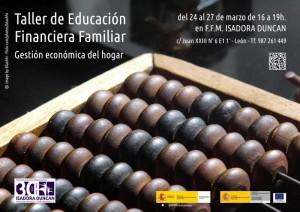
La F.F.M. Isadora Duncan pone en marcha dentro del Programa de Educación Financiera Familiar y Pobreza Energética un nuevo taller titulado Taller de Educación Financiera Familiar: Gestión Económica del Hogar, subvencionado por el Ministerio de Sanidad, Servicios Sociales e Igualdad. Está dirigido a todas aquellas personas que deseen aprender a gestionar las finanzas de un hogar, tipos de financiación, ayudas sociales, alquileres, hipotecas y legislación básica.

Este nuevo taller comienza el lunes 9 de junio y finaliza el jueves 12 de junio, el horario es de tardes, de 16:00 a 19:00 horas de lunes a jueves.

Durante el taller habrá un Servicio de Conciliación gratuito para aquellas personas que asistan al taller y no tengan con quien dejar a sus peques.

El plazo de inscripción ya está abierto, aunque el aforo es limitado por lo que las personas interesadas deberán formalizar la matrícula cuanto antes. Para más información pueden acudir a la sede de nuestra fundación situada en la Avda. Reino de León, 12, E1, 1º, o bien llamar al teléfono 987261449.

Taller de Educación Financiera Familiar y Gestión Económica del Hogar

Taller de Educación Financiera Familiar y Gestión Económica del Hogar
Cerrar
10

Categoría: GeneralTaller de Educación Financiera Familiar y Gestión Económica del Hogar

Cerrar

10 junio, 2014 4:00 pm – 7:00 pm

La F.F.M. Isadora Duncan pone en marcha dentro del Programa de Educación Financiera Familiar y Pobreza Energética un nuevo taller titulado Taller de Educación Financiera Familiar: Gestión Económica del Hogar, subvencionado por el Ministerio de Sanidad, Servicios Sociales e Igualdad. Está dirigido a todas aquellas personas que deseen aprender a gestionar las finanzas de un hogar, tipos de financiación, ayudas sociales, alquileres, hipotecas y legislación básica.

Este nuevo taller comienza el lunes 9 de junio y finaliza el jueves 12 de junio, el horario es de tardes, de 16:00 a 19:00 horas de lunes a jueves.

Durante el taller habrá un Servicio de Conciliación gratuito para aquellas personas que asistan al taller y no tengan con quien dejar a sus peques.

El plazo de inscripción ya está abierto, aunque el aforo es limitado por lo que las personas interesadas deberán formalizar la matrícula cuanto antes. Para más información pueden acudir a la sede de nuestra fundación situada en la Avda. Reino de León, 12, E1, 1º, o bien llamar al teléfono 987261449.

Taller de Educación Financiera Familiar y Gestión Económica del Hogar

Taller de Educación Financiera Familiar y Gestión Económica del Hogar

Cerrar
11

Categoría: GeneralTaller de Educación Financiera Familiar y Gestión Económica del Hogar

Cerrar

11 junio, 2014 4:00 pm – 7:00 pm

La F.F.M. Isadora Duncan pone en marcha dentro del Programa de Educación Financiera Familiar y Pobreza Energética un nuevo taller titulado Taller de Educación Financiera Familiar: Gestión Económica del Hogar, subvencionado por el Ministerio de Sanidad, Servicios Sociales e Igualdad. Está dirigido a todas aquellas personas que deseen aprender a gestionar las finanzas de un hogar, tipos de financiación, ayudas sociales, alquileres, hipotecas y legislación básica.

Este nuevo taller comienza el lunes 9 de junio y finaliza el jueves 12 de junio, el horario es de tardes, de 16:00 a 19:00 horas de lunes a jueves.

Durante el taller habrá un Servicio de Conciliación gratuito para aquellas personas que asistan al taller y no tengan con quien dejar a sus peques.

El plazo de inscripción ya está abierto, aunque el aforo es limitado por lo que las personas interesadas deberán formalizar la matrícula cuanto antes. Para más información pueden acudir a la sede de nuestra fundación situada en la Avda. Reino de León, 12, E1, 1º, o bien llamar al teléfono 987261449.

Taller de Educación Financiera Familiar y Gestión Económica del Hogar

Taller de Educación Financiera Familiar y Gestión Económica del Hogar

Cerrar

Categoría: General2014: la inversión en momentos de incertidumbre

Cerrar

11 junio, 2014 6:00 pm

Rankia te invita a la jornada "2014: La inversión en momentos de incertidumbre" del próximo miércoles 11 de junio a las 18:00h en la Bolsa de Madrid.

Una jornada en la que las gestoras de fondos internacionales Allianz, Franklin Templeton y Pioneer nos ofrecerán su visión de mercado en la actualidad y nos darán las claves de inversión en 2014. Además, la mesa redonda estará moderada por José María Luna, director de análisis financiero de Profim EAFI.

2014: la inversión en momentos de incertidumbre

Cerrar
12

Categoría: GeneralTaller de Educación Financiera Familiar y Gestión Económica del Hogar

Cerrar

12 junio, 2014 4:00 pm – 7:00 pm

La F.F.M. Isadora Duncan pone en marcha dentro del Programa de Educación Financiera Familiar y Pobreza Energética un nuevo taller titulado Taller de Educación Financiera Familiar: Gestión Económica del Hogar, subvencionado por el Ministerio de Sanidad, Servicios Sociales e Igualdad. Está dirigido a todas aquellas personas que deseen aprender a gestionar las finanzas de un hogar, tipos de financiación, ayudas sociales, alquileres, hipotecas y legislación básica.

Este nuevo taller comienza el lunes 9 de junio y finaliza el jueves 12 de junio, el horario es de tardes, de 16:00 a 19:00 horas de lunes a jueves.

Durante el taller habrá un Servicio de Conciliación gratuito para aquellas personas que asistan al taller y no tengan con quien dejar a sus peques.

El plazo de inscripción ya está abierto, aunque el aforo es limitado por lo que las personas interesadas deberán formalizar la matrícula cuanto antes. Para más información pueden acudir a la sede de nuestra fundación situada en la Avda. Reino de León, 12, E1, 1º, o bien llamar al teléfono 987261449.

Taller de Educación Financiera Familiar y Gestión Económica del Hogar

Taller de Educación Financiera Familiar y Gestión Económica del Hogar
Cerrar
13 14 15
16 17 18 19 20 21 22
23 24 25 26 27

Categoría: GeneralWEBINAR: Savings and Retail Banks building financial capabilities of children and youth

Cerrar

27 junio, 2014 3:00 pm – 5:06 pm

Webinar: “Banco Caja Social and MicroBank: Savings and Retail Banks building financial capabilities of children and youth”

http://childfinanceinternational.org/news-and-events/news-blog/entry/webinar-savings-and-retail-banks-building-financial-capabilities-of-children-and-youth

Partners Child and Youth Finance International (CYFI) and the World Savings and Retail Banking Institute (WSBI) invite you to join us for an exciting webinar with presentations of pioneering savings banks building financial capabilities of children and youth.

Banco Caja Social (Colombia) and MicroBank (Spain) will present the ways in which they are supporting financial inclusion of young people while building their financial capabilities. BCS, partner of the YouthSave consortium, offers savings accounts to children in combination with elements of financial education. MicroBank partners with a large number of local social sector and municipal institutions to build young people’s financial and entrepreneurship capabilities before providing them with loans or financing for their ventures.

Both cases provide interesting models on how financial institutions can shape their interaction with, and responsibility towards a new generation of customers, and how a multi-stakeholder approach can provide added value to all parties involved.

Join us on June 25 at 3pm CET to hear their experiences first-hand and to get practical advice for your own organization, partner-program, or community.

Don’t miss it!

WEBINAR: Savings and Retail Banks building financial capabilities of children and youth

Cerrar
28 29
30 1 2 3 4 5 6

Categorías

  • General
EFFEC
Tags
EspañaEDUCACION FINANCIERAEducació Financerafinancial literacyEducaciónjóvenesahorroIEFocdeUSAcatalunyafinanzas personalesmaterial docenteEFECamerica latinaUEeconomía domésticaeuropapisaUKcnmvinversorEducaciójubilaciónefpaPROGRAMA EFECappcatalàdinerodinerseducació financieranensniñoscrèditcréditofinances personalscrisishipotecaresearchwebAgendaDebtpayday loanscinechile
Newsletter

IEF
2014 © Educació Financera